MSEL - Overview
With the advent of artificial intelligence, today's IC industry keeps moving toward new territories with continued technology scaling. It is not uncommon to find that a circuit solution that was traditionally deemed optimal is no longer a good idea in today's standard. The optimal solutions to today's most challenging problems are often based upon various analog and digital signal processing functions on a tiny silicon substrate. In MSEL, we are devoted to conducting innovative researches that address the most challenging problems in modern mixed-signal IC designs.
Our current research focus includes following areas:
High-Performance A/D Converter Design
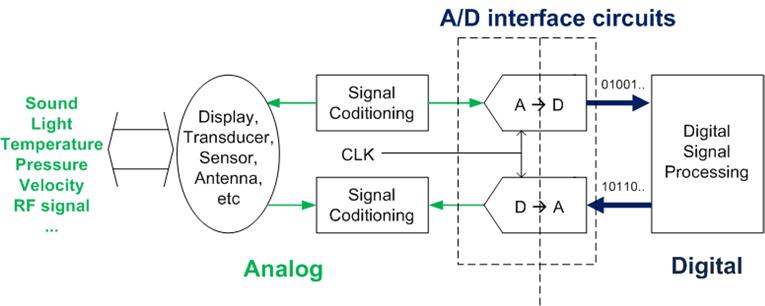 |
A/D and D/A interface circuits, or data converters, are inevitable mixed-signal IC building blocks any modern electronic devices. With continued technology scaling, a number of signal processing that were traditionally performed in analog domain are now handled in digital domain with better energy and area efficiency. To enable this trend, mixed-signal IC design in nanometer-scale technology requires energy-efficient data converters in a small silicon area. MSEL is focused on very high speed (> Gsps) data converter designs as well as extremely low power data converters for various sensor applications.
High-Speed Interface Circuit Design
When we talk about the meteoric rise of Artificial Intelligence, the spotlight almost always lands on the monsters of computing: massive Graphics Processing Units (GPUs), Tensor Processing Units (TPUs), and trillion-parameter Large Language Models (LLMs). We marvel at how many teraflops of raw processing power can be packed onto a single silicon die.
But there is a quiet crisis brewing in the background of AI hardware. Giving a system massive computational power without a way to move data in and out of it is like putting a rocket engine inside a delivery van—you have immense power, but you are still stuck in traffic.
This is where High-Speed Interface (HSI) circuit design steps in. It is the unsung hero of modern AI computing, and it is quickly becoming the primary battleground for the future of technology. As processors got exponentially faster, the physical wires connecting them to memory didn't keep up. This gap is known as the “Memory Wall.” In AI computing, this manifests as data starvation—the incredibly expensive, high-powered GPU sits idle, burning electricity, simply waiting for the next batch of data to arrive from memory.
Without high-speed interfaces, the AI revolution hits a hard ceiling. MSEL is working on designing high-speed on-chip/off-chip I/O transceivers in nanometer-scale CMOS technologies.